
Trader Psychology: The Trader You Need to Beat Is Yourself

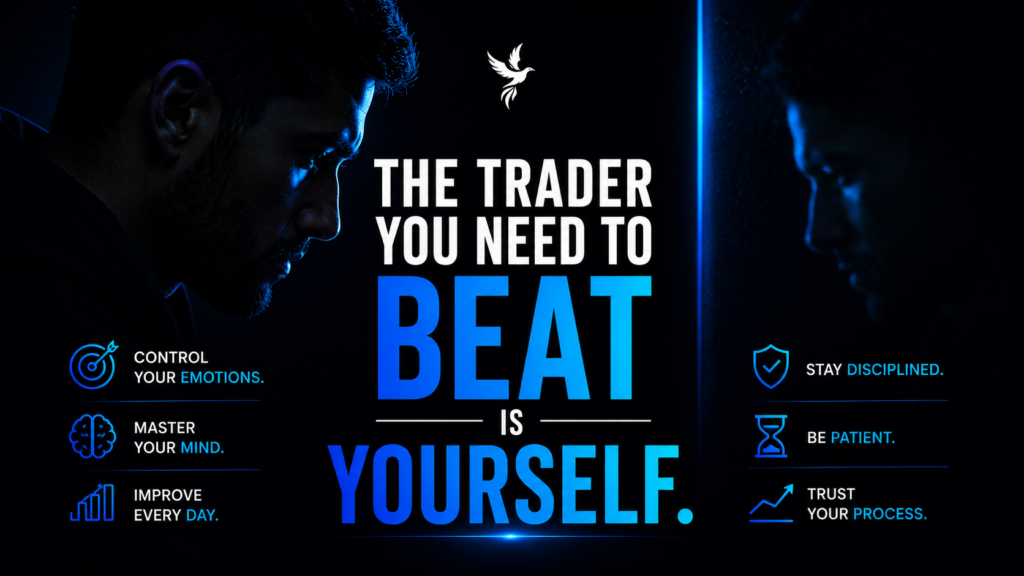
Trader Psychology is one of the biggest factors separating consistently profitable traders from those who struggle. While many believe the market is their greatest opponent, the truth is that the hardest battle happens internally. Fear, greed, impatience, and self-doubt often have a greater impact on trading results than any strategy or indicator.
Most traders believe they’re competing against the market.
They spend countless hours studying price action, learning technical analysis, testing indicators, and searching for the perfect strategy.
But after months—or even years—many realize something surprising.
The market was never their biggest opponent.
They were.
One of the most important lessons in building a strong trading mindset is understanding that success isn’t determined by defeating the market. It’s determined by mastering yourself.
The charts don’t force you to overtrade.
The market doesn’t make you move your stop loss.
Price doesn’t tell you to risk more than your plan allows.
Those decisions come from within.
Why Trader Psychology Matters More Than the Market
The forex market has no emotions.
It doesn’t know your account balance.
It doesn’t care whether you won or lost your last trade.
The market simply moves according to supply and demand.
What creates problems isn’t the market itself—it’s how traders respond to it.
Two traders can look at the same chart.
One follows their trading plan with patience.
The other enters emotionally, chases the market, and exits too early.
The difference isn’t technical knowledge.
It’s mindset.
Trader Psychology: Your Biggest Opponent Is Yourself
Every trader faces an internal battle.
That battle often shows up as:
- Fear of losing money.
- Fear of missing out.
- Greed after a winning streak.
- Revenge trading after a loss.
- Impatience during slow markets.
- Self-doubt after a series of losing trades.
These emotions influence decisions far more than most traders realize.
The market simply exposes what’s already happening inside your mind.
The Habits That Hold Traders Back
Many traders don’t lose because they lack knowledge.
They lose because they repeatedly make emotional decisions.
Some of the most common habits include:
Overtrading
Taking trades simply because you feel the need to stay active.
Moving Stop Losses
Refusing to accept a planned loss and hoping the market will turn around.
Closing Winning Trades Too Early
Allowing fear to override your trading plan.
Ignoring Risk Management
Increasing position sizes after losses in an attempt to recover quickly.
Constantly Changing Strategies
Abandoning a proven system after a few losing trades instead of trusting the long-term process.
Each of these habits reflects a weakness in mindset rather than strategy.
Building Strong Trader Psychology
Developing a strong trading mindset doesn’t happen overnight.
It requires consistent self-awareness and discipline.
Professional traders understand that every trade offers two opportunities:
One to make money.
The other to learn something about themselves.
They review their decisions honestly.
They identify emotional triggers.
And they work to improve their behavior—not just their strategy.
Focus on Process, Not Perfection
Many traders chase perfection.
They want a strategy that never loses.
They want every trade to be profitable.
But perfection doesn’t exist in trading.
Consistency does.
Successful traders focus on:
- Following their trading plan.
- Managing risk consistently.
- Accepting losses professionally.
- Remaining patient during uncertainty.
- Making disciplined decisions repeatedly.
Their confidence comes from trusting their process, not predicting every market move.
Questions Every Trader Should Ask
Before entering your next trade, ask yourself:
- Am I following my trading plan?
- Am I trading because of a valid setup or because I’m emotional?
- Would I take this trade if nobody else could see the result?
- Am I trying to prove something, or am I simply following my process?
These questions help shift your focus away from emotion and back to discipline.
Becoming the Trader You Want to Be
Every successful trader reaches a point where they stop blaming the market.
Instead, they begin taking responsibility for their decisions.
That’s when real growth begins.
The market doesn’t reward intelligence alone.
It rewards patience.
Discipline.
Risk management.
Consistency.
And emotional control.
Those qualities are developed by working on yourself every day.
Final Thoughts on Trader Psychology
The trader you need to beat isn’t sitting behind another screen.
It isn’t a hedge fund.
It isn’t an algorithm.
It’s the version of yourself that trades emotionally, breaks rules, chases losses, and acts out of fear instead of discipline.
Master that trader, and you’ll be much closer to mastering the market.
Because in the end, the greatest edge in trading isn’t found in an indicator.
It’s found in your mindset.
Continue Your Trading Journey
If you’re committed to developing a stronger trading mindset, join our community for weekly insights on trading psychology, discipline, risk management, and the habits that help traders build long-term consistency.
The market will always test your strategy.
But every trade will also test your character.
Choose growth over emotion, and let discipline become your greatest advantage.
You might also find our article on Managing Your Emotions helpful

Responses