

The Boredom Trap: Why Doing Nothing Is So Hard for Forex Traders

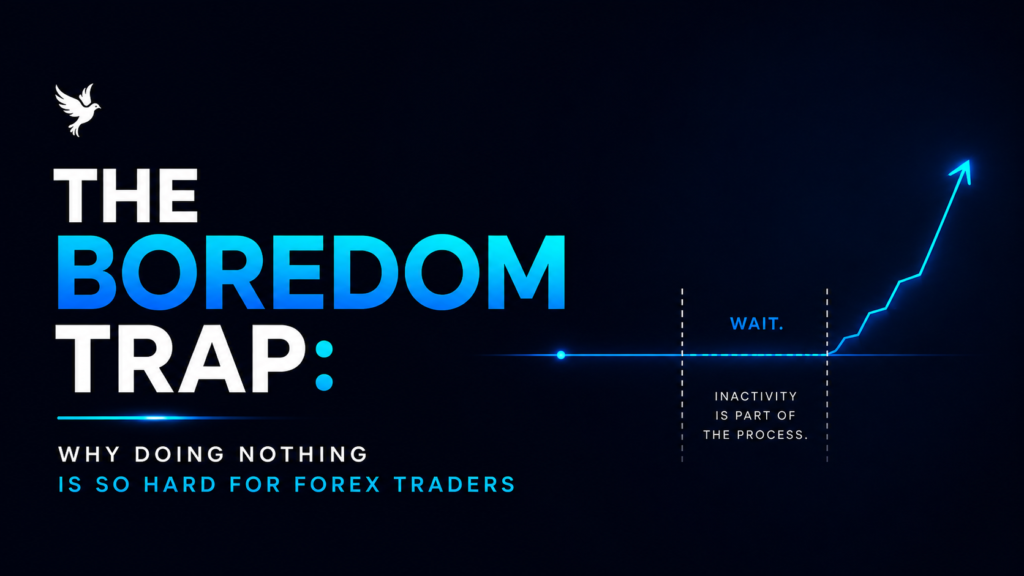
Sometimes the Best Trade Is No Trade
Forex trading psychology is not only about controlling fear and greed. It also involves understanding what happens when the market gives you nothing to do.
You open your charts.
You check the market.
Nothing interesting is happening.
After another 10 minutes, things still look the same.
Then another 20 minutes pass, and you start getting restless.
Instead of watching one pair, you begin moving between different markets.
EUR/USD looks quiet.
GBP/USD isn’t giving you anything either.
Gold is moving a little, so you zoom in.
Then you zoom out.
You change your timeframe.
Eventually, you notice something that might be a setup.
It isn’t really your setup.
However, it looks close enough.
Then comes the thought:
“Maybe I can take a small position.”
That’s how it starts.
Not necessarily with greed.
Not always with revenge.
Sometimes, it starts with something much simpler:
Boredom.
And boredom is one of the most underestimated problems in forex trading.
When there is nothing to do, many traders feel like they should be doing something.
Unfortunately, that’s exactly when patience can disappear.
Why Forex Trading Psychology Matters When the Market Is Quiet
Most conversations about forex trading psychology focus on obvious emotions.
Fear.
Greed.
FOMO.
Revenge trading.
Overconfidence.
However, boredom deserves just as much attention.
A quiet market can create a strange psychological pressure.
You sit in front of your screen expecting an opportunity to appear.
Yet the market doesn’t operate according to your schedule.
It doesn’t care that you’ve been watching for two hours.
It doesn’t care that you haven’t taken a trade today.
Most importantly, it doesn’t owe you an entry.
Still, after sitting and waiting, a thought can slowly creep in:
“I haven’t traded anything today.”
That sentence sounds harmless.
In reality, it can quietly turn trading into an activity rather than a process.
As a result, you begin measuring productivity by the number of trades you take.
More trades start to feel like more progress.
But that’s not necessarily true.
More trading does not automatically mean better trading.
Sometimes the most productive thing you can do is nothing.
The Psychology Behind Trading Boredom
This is where forex trading psychology becomes particularly interesting.
Humans generally don’t enjoy uncertainty.
At the same time, we don’t like inactivity when we believe we should be making progress.
Trading combines both.
You don’t know exactly what the market will do, yet you’re expected to sit there and wait.
Naturally, that can feel uncomfortable.
Your brain wants stimulation.
It wants a decision.
It wants an outcome.
Therefore, when the market isn’t giving you a clear opportunity, your mind may start creating one.
Suddenly, a weak setup looks interesting.
A random price movement begins to look like a breakout.
A small pullback becomes a possible entry.
You’re not necessarily seeing a better opportunity.
Instead, you may simply be becoming less comfortable with waiting.
How Boredom Leads to Overtrading
Overtrading isn’t always caused by greed.
In many cases, boredom plays a role.
You take one trade because you’re bored.
Then another because the first one isn’t moving quickly enough.
After that, you take another because you haven’t had a winner yet.
Before you realize it, you’ve taken five trades when your original plan only called for one or two high-quality setups.
The problem isn’t necessarily that every trade looked terrible.
Rather, you were trading because you wanted action, not because the market gave you a genuine opportunity.
That’s an important distinction.
A professional mindset asks:
“Is there a valid setup?”
A bored mindset asks:
“What can I trade?”
Those questions sound similar.
However, they lead to completely different decisions.
This is one of the most important lessons in forex trading psychology: the desire to participate can become stronger than the reason to participate.
The Market Doesn’t Pay You for Being Busy
This is one of the hardest lessons for new traders to accept.
You can spend six hours studying charts and take zero trades.
That can still be a successful trading day.
On the other hand, you could spend 30 minutes looking at charts, take four impulsive trades, and finish the day with a loss.
Being active doesn’t mean you were productive.
Trading isn’t like a traditional job where eight hours of work should produce eight hours of output.
The market doesn’t reward you simply for staring at charts.
Instead, it rewards good decisions.
Consequently, sometimes a good decision is deciding not to participate.
A trader who understands forex trading psychology eventually realizes that inactivity can be part of a successful process.
The “I Need a Trade Today” Mindset
Have you ever started a trading session thinking:
“I need to make something today.”
Maybe you have a financial target.
Perhaps you’ve had several days without a trade.
Or maybe you’ve been watching other traders post winning results online.
Whatever the reason, you now feel pressure to produce a result.
That’s dangerous.
You’ve changed the objective from:
“Wait for my setup.”
to:
“Find something that can make me money.”
That second mindset creates problems.
For example, a setup that normally requires four confirmations suddenly only needs two.
Likewise, a trade you would have ignored yesterday suddenly looks attractive.
Your entry criteria become flexible.
Your risk management becomes negotiable.
Slowly, boredom turns into impatience.
And once impatience enters the decision-making process, your trading plan can become easier to break.
Social Media Makes the Boredom Trap Worse
There’s another factor modern traders have to deal with.
You can spend an entire morning waiting for a setup.
Then you open social media.
Someone has just posted:
+187 pips.
Another trader shares a screenshot of a profitable trade.
Someone else says they caught the exact move you’ve been waiting for.
Suddenly, you’re thinking:
“Everyone is making money except me.”
That’s when boredom can turn into FOMO.
Instead of feeling comfortable with waiting, you start feeling behind.
Consequently, you’re more likely to chase.
The market hasn’t changed.
Your perception of your own performance has changed.
This is why understanding forex trading psychology is so important in today’s trading environment.
You don’t see another trader’s missed opportunities.
You don’t see their losing days.
You don’t see the trades they regret.
Instead, you see the screenshot.
Then you feel like you need to create your own screenshot.
That’s not a trading strategy.
That’s emotional pressure.
Patience Is Part of Forex Trading Psychology
This is an important mindset shift.
When traders hear “be patient,” they sometimes think patience means sitting around doing nothing.
It doesn’t.
Patience is an active decision.
When you’re waiting for your setup, you’re doing something important.
You’re protecting your capital.
You’re protecting your attention.
You’re protecting your trading plan.
Most importantly, you’re refusing to trade simply because the market hasn’t given you a reason to trade.
That’s not laziness.
That’s discipline.
In fact, sometimes the hardest decision in trading is looking at a chart and saying:
“There is nothing here for me.”
Then closing the chart.
That ability to walk away is one of the clearest signs of developing emotional control.
What Experienced Traders Understand About Opportunity
One of the biggest mindset changes in trading is understanding that you don’t need to participate in every market move.
There will always be another setup.
Another session.
Another trading day.
Another opportunity.
Therefore, you don’t have to catch every move.
You only need to participate when the conditions match your strategy.
Think about it this way.
If your strategy produces five genuinely high-quality opportunities in a week, why would you create ten additional trades just because you were bored?
You’re not increasing your edge.
Instead, you’re increasing your exposure to mistakes.
A strong forex trading psychology allows you to accept that missing a trade is sometimes better than forcing one.
The Difference Between Watching and Trading
You can watch the market without trading it.
That sounds obvious, but many traders struggle with it.
They believe that if they’re watching a chart, they should eventually take a position.
You don’t.
You can study price action.
You can observe market structure.
You can mark important levels.
You can take notes.
You can review previous trades.
You can simply wait.
Watching the market doesn’t create an obligation to trade.
That’s a powerful mindset to develop.
How to Beat the Boredom Trap
1. Define What a Valid Setup Looks Like
Before you start trading, know exactly what you’re waiting for.
For example:
- Specific market structure
- Specific entry condition
- Defined risk
- Defined invalidation
- Acceptable risk-to-reward
- Confirmation requirements
If those conditions aren’t present, there is no trade.
As a result, you remove much of the room for emotional negotiation.
2. Create a “No Setup, No Trade” Rule
Make this one of your simplest rules:
No setup = no trade.
Not:
“Maybe I’ll take a small one.”
Not:
“I’ll just test the market.”
Not:
“It looks like it’s about to move.”
If your criteria aren’t met, stay out.
Simple rules are easier to follow when your patience starts running low.
3. Give Yourself Something Else to Do
One of the easiest ways to overcome trading boredom is to stop making the chart your entire source of stimulation.
When there is no setup, use the time productively.
Review your trading journal.
Study previous trades.
Work on your strategy.
Analyze your mistakes.
Read about market psychology.
Go for a walk.
Exercise.
Take a break.
The goal isn’t to stare at the chart until something happens.
Instead, the goal is to be prepared when something does.
This approach can also strengthen your overall forex trading psychology, because you’re learning to separate productivity from constant market participation.
4. Set Trading Windows
You don’t necessarily need to watch the market all day.
Choose specific periods when your strategy is most likely to produce opportunities.
Then step away outside those periods.
This can reduce unnecessary screen time and the temptation to manufacture trades.
More screen time doesn’t automatically create better opportunities.
Sometimes it simply gives your emotions more opportunities to interfere.
5. Track the Trades You Didn’t Take
This is a powerful exercise.
At the end of the week, review the trades you wanted to take but didn’t.
Ask:
“What would have happened if I had entered?”
You’ll probably find some winners.
That’s normal.
However, you’ll also discover losing trades you successfully avoided.
Start celebrating those.
Because avoiding a bad trade is still a good decision.
Learn to Be Proud of a No-Trade Day
This might feel strange at first.
Imagine finishing a trading day with:
0 trades.
$0 profit.
$0 loss.
And feeling good about it.
Why?
Because you followed your plan.
You didn’t force anything.
You didn’t chase.
You didn’t overtrade.
You protected your capital.
That’s a successful day.
Not every successful trading day needs to show a profit.
Sometimes success is simply not making a bad decision.
This is where good forex trading psychology begins to separate itself from the need for constant action.
The Boredom Test
Here’s a simple test you can use during your next trading session.
When you feel the urge to enter a trade, ask yourself:
“If I wasn’t bored right now, would I still take this trade?”
If the answer is no, step away.
Next, ask:
“Does this setup meet every requirement in my trading plan?”
If the answer is no, step away.
Finally, ask:
“Am I trading because the market gave me an opportunity, or because I want something to happen?”
That final question can expose a lot.
The Best Traders Are Comfortable With Missing Out
You will miss trades.
Accept it.
You’ll see a move after you decided not to enter.
You’ll watch a currency pair run exactly where you predicted.
You’ll see someone else catch the trade.
Naturally, you might think:
“I should have taken that.”
Maybe you should have.
However, that doesn’t mean the next trade should be taken impulsively.
One missed opportunity doesn’t justify taking the next bad opportunity.
Your job isn’t to catch everything.
Your job is to execute your strategy when your conditions are present.
That mindset is central to healthy forex trading psychology.
Final Thoughts
The market will always create movement.
There will always be another candle.
Another breakout.
Another pullback.
Another headline.
Another opportunity that looks like the one you missed yesterday.
You don’t need to trade all of them.
In fact, trying to trade everything can be exactly what prevents you from becoming consistent.
Eventually, the mature trader learns something that feels uncomfortable at first:
Doing nothing is still a decision.
Sometimes, it’s the best decision you can make.
When there is no setup, don’t create one.
When the market isn’t offering your opportunity, don’t force it.
When you’re bored, don’t let boredom become a trading signal.
And when you feel like you have to trade, remember:
The market doesn’t pay you for how many trades you take.
It rewards the quality of the decisions you make.
Your edge isn’t just knowing when to enter.
Your edge is also knowing when to stay out.
A Question for the Community
Be honest:
What’s harder for you — taking a losing trade or sitting in front of the charts and taking no trade at all?
Your answer might reveal more about your trading psychology than you think.Sometimes the Best Trade Is No Trade
Forex trading psychology is not only about controlling fear and greed. It also involves understanding what happens when the market gives you nothing to do.
You open your charts.
You check the market.
Nothing interesting is happening.
After another 10 minutes, things still look the same.
Then another 20 minutes pass, and you start getting restless.
Instead of watching one pair, you begin moving between different markets.
EUR/USD looks quiet.
GBP/USD isn’t giving you anything either.
Gold is moving a little, so you zoom in.
Then you zoom out.
You change your timeframe.
Eventually, you notice something that might be a setup.
It isn’t really your setup.
However, it looks close enough.
Then comes the thought:
“Maybe I can take a small position.”
That’s how it starts.
Not necessarily with greed.
Not always with revenge.
Sometimes, it starts with something much simpler:
Boredom.
And boredom is one of the most underestimated problems in forex trading.
When there is nothing to do, many traders feel like they should be doing something.
Unfortunately, that’s exactly when patience can disappear.
Why Forex Trading Psychology Matters When the Market Is Quiet
Most conversations about forex trading psychology focus on obvious emotions.
Fear.
Greed.
FOMO.
Revenge trading.
Overconfidence.
However, boredom deserves just as much attention.
A quiet market can create a strange psychological pressure.
You sit in front of your screen expecting an opportunity to appear.
Yet the market doesn’t operate according to your schedule.
It doesn’t care that you’ve been watching for two hours.
It doesn’t care that you haven’t taken a trade today.
Most importantly, it doesn’t owe you an entry.
Still, after sitting and waiting, a thought can slowly creep in:
“I haven’t traded anything today.”
That sentence sounds harmless.
In reality, it can quietly turn trading into an activity rather than a process.
As a result, you begin measuring productivity by the number of trades you take.
More trades start to feel like more progress.
But that’s not necessarily true.
More trading does not automatically mean better trading.
Sometimes the most productive thing you can do is nothing.
The Psychology Behind Trading Boredom
This is where forex trading psychology becomes particularly interesting.
Humans generally don’t enjoy uncertainty.
At the same time, we don’t like inactivity when we believe we should be making progress.
Trading combines both.
You don’t know exactly what the market will do, yet you’re expected to sit there and wait.
Naturally, that can feel uncomfortable.
Your brain wants stimulation.
It wants a decision.
It wants an outcome.
Therefore, when the market isn’t giving you a clear opportunity, your mind may start creating one.
Suddenly, a weak setup looks interesting.
A random price movement begins to look like a breakout.
A small pullback becomes a possible entry.
You’re not necessarily seeing a better opportunity.
Instead, you may simply be becoming less comfortable with waiting.
How Boredom Leads to Overtrading
Overtrading isn’t always caused by greed.
In many cases, boredom plays a role.
You take one trade because you’re bored.
Then another because the first one isn’t moving quickly enough.
After that, you take another because you haven’t had a winner yet.
Before you realize it, you’ve taken five trades when your original plan only called for one or two high-quality setups.
The problem isn’t necessarily that every trade looked terrible.
Rather, you were trading because you wanted action, not because the market gave you a genuine opportunity.
That’s an important distinction.
A professional mindset asks:
“Is there a valid setup?”
A bored mindset asks:
“What can I trade?”
Those questions sound similar.
However, they lead to completely different decisions.
This is one of the most important lessons in forex trading psychology: the desire to participate can become stronger than the reason to participate.
The Market Doesn’t Pay You for Being Busy
This is one of the hardest lessons for new traders to accept.
You can spend six hours studying charts and take zero trades.
That can still be a successful trading day.
On the other hand, you could spend 30 minutes looking at charts, take four impulsive trades, and finish the day with a loss.
Being active doesn’t mean you were productive.
Trading isn’t like a traditional job where eight hours of work should produce eight hours of output.
The market doesn’t reward you simply for staring at charts.
Instead, it rewards good decisions.
Consequently, sometimes a good decision is deciding not to participate.
A trader who understands forex trading psychology eventually realizes that inactivity can be part of a successful process.
The “I Need a Trade Today” Mindset
Have you ever started a trading session thinking:
“I need to make something today.”
Maybe you have a financial target.
Perhaps you’ve had several days without a trade.
Or maybe you’ve been watching other traders post winning results online.
Whatever the reason, you now feel pressure to produce a result.
That’s dangerous.
You’ve changed the objective from:
“Wait for my setup.”
to:
“Find something that can make me money.”
That second mindset creates problems.
For example, a setup that normally requires four confirmations suddenly only needs two.
Likewise, a trade you would have ignored yesterday suddenly looks attractive.
Your entry criteria become flexible.
Your risk management becomes negotiable.
Slowly, boredom turns into impatience.
And once impatience enters the decision-making process, your trading plan can become easier to break.
Social Media Makes the Boredom Trap Worse
There’s another factor modern traders have to deal with.
You can spend an entire morning waiting for a setup.
Then you open social media.
Someone has just posted:
+187 pips.
Another trader shares a screenshot of a profitable trade.
Someone else says they caught the exact move you’ve been waiting for.
Suddenly, you’re thinking:
“Everyone is making money except me.”
That’s when boredom can turn into FOMO.
Instead of feeling comfortable with waiting, you start feeling behind.
Consequently, you’re more likely to chase.
The market hasn’t changed.
Your perception of your own performance has changed.
This is why understanding forex trading psychology is so important in today’s trading environment.
You don’t see another trader’s missed opportunities.
You don’t see their losing days.
You don’t see the trades they regret.
Instead, you see the screenshot.
Then you feel like you need to create your own screenshot.
That’s not a trading strategy.
That’s emotional pressure.
Patience Is Part of Forex Trading Psychology
This is an important mindset shift.
When traders hear “be patient,” they sometimes think patience means sitting around doing nothing.
It doesn’t.
Patience is an active decision.
When you’re waiting for your setup, you’re doing something important.
You’re protecting your capital.
You’re protecting your attention.
You’re protecting your trading plan.
Most importantly, you’re refusing to trade simply because the market hasn’t given you a reason to trade.
That’s not laziness.
That’s discipline.
In fact, sometimes the hardest decision in trading is looking at a chart and saying:
“There is nothing here for me.”
Then closing the chart.
That ability to walk away is one of the clearest signs of developing emotional control.
What Experienced Traders Understand About Opportunity
One of the biggest mindset changes in trading is understanding that you don’t need to participate in every market move.
There will always be another setup.
Another session.
Another trading day.
Another opportunity.
Therefore, you don’t have to catch every move.
You only need to participate when the conditions match your strategy.
Think about it this way.
If your strategy produces five genuinely high-quality opportunities in a week, why would you create ten additional trades just because you were bored?
You’re not increasing your edge.
Instead, you’re increasing your exposure to mistakes.
A strong forex trading psychology allows you to accept that missing a trade is sometimes better than forcing one.
The Difference Between Watching and Trading
You can watch the market without trading it.
That sounds obvious, but many traders struggle with it.
They believe that if they’re watching a chart, they should eventually take a position.
You don’t.
You can study price action.
You can observe market structure.
You can mark important levels.
You can take notes.
You can review previous trades.
You can simply wait.
Watching the market doesn’t create an obligation to trade.
That’s a powerful mindset to develop.
How to Beat the Boredom Trap
1. Define What a Valid Setup Looks Like
Before you start trading, know exactly what you’re waiting for.
For example:
- Specific market structure
- Specific entry condition
- Defined risk
- Defined invalidation
- Acceptable risk-to-reward
- Confirmation requirements
If those conditions aren’t present, there is no trade.
As a result, you remove much of the room for emotional negotiation.
2. Create a “No Setup, No Trade” Rule
Make this one of your simplest rules:
No setup = no trade.
Not:
“Maybe I’ll take a small one.”
Not:
“I’ll just test the market.”
Not:
“It looks like it’s about to move.”
If your criteria aren’t met, stay out.
Simple rules are easier to follow when your patience starts running low.
3. Give Yourself Something Else to Do
One of the easiest ways to overcome trading boredom is to stop making the chart your entire source of stimulation.
When there is no setup, use the time productively.
Review your trading journal.
Study previous trades.
Work on your strategy.
Analyze your mistakes.
Read about market psychology.
Go for a walk.
Exercise.
Take a break.
The goal isn’t to stare at the chart until something happens.
Instead, the goal is to be prepared when something does.
This approach can also strengthen your overall forex trading psychology, because you’re learning to separate productivity from constant market participation.
4. Set Trading Windows
You don’t necessarily need to watch the market all day.
Choose specific periods when your strategy is most likely to produce opportunities.
Then step away outside those periods.
This can reduce unnecessary screen time and the temptation to manufacture trades.
More screen time doesn’t automatically create better opportunities.
Sometimes it simply gives your emotions more opportunities to interfere.
5. Track the Trades You Didn’t Take
This is a powerful exercise.
At the end of the week, review the trades you wanted to take but didn’t.
Ask:
“What would have happened if I had entered?”
You’ll probably find some winners.
That’s normal.
However, you’ll also discover losing trades you successfully avoided.
Start celebrating those.
Because avoiding a bad trade is still a good decision.
Learn to Be Proud of a No-Trade Day
This might feel strange at first.
Imagine finishing a trading day with:
0 trades.
$0 profit.
$0 loss.
And feeling good about it.
Why?
Because you followed your plan.
You didn’t force anything.
You didn’t chase.
You didn’t overtrade.
You protected your capital.
That’s a successful day.
Not every successful trading day needs to show a profit.
Sometimes success is simply not making a bad decision.
This is where good forex trading psychology begins to separate itself from the need for constant action.
The Boredom Test
Here’s a simple test you can use during your next trading session.
When you feel the urge to enter a trade, ask yourself:
“If I wasn’t bored right now, would I still take this trade?”
If the answer is no, step away.
Next, ask:
“Does this setup meet every requirement in my trading plan?”
If the answer is no, step away.
Finally, ask:
“Am I trading because the market gave me an opportunity, or because I want something to happen?”
That final question can expose a lot.
The Best Traders Are Comfortable With Missing Out
You will miss trades.
Accept it.
You’ll see a move after you decided not to enter.
You’ll watch a currency pair run exactly where you predicted.
You’ll see someone else catch the trade.
Naturally, you might think:
“I should have taken that.”
Maybe you should have.
However, that doesn’t mean the next trade should be taken impulsively.
One missed opportunity doesn’t justify taking the next bad opportunity.
Your job isn’t to catch everything.
Your job is to execute your strategy when your conditions are present.
That mindset is central to healthy forex trading psychology.
Final Thoughts
The market will always create movement.
There will always be another candle.
Another breakout.
Another pullback.
Another headline.
Another opportunity that looks like the one you missed yesterday.
You don’t need to trade all of them.
In fact, trying to trade everything can be exactly what prevents you from becoming consistent.
Eventually, the mature trader learns something that feels uncomfortable at first:
Doing nothing is still a decision.
Sometimes, it’s the best decision you can make.
When there is no setup, don’t create one.
When the market isn’t offering your opportunity, don’t force it.
When you’re bored, don’t let boredom become a trading signal.
And when you feel like you have to trade, remember:
The market doesn’t pay you for how many trades you take.
It rewards the quality of the decisions you make.
Your edge isn’t just knowing when to enter.
Your edge is also knowing when to stay out.
A Question for the Community
Be honest:
What’s harder for you — taking a losing trade or sitting in front of the charts and taking no trade at all?
Your answer might reveal more about your trading psychology than you think.

Responses