
The Trader Who Knows What to Do but Still Can’t Do It

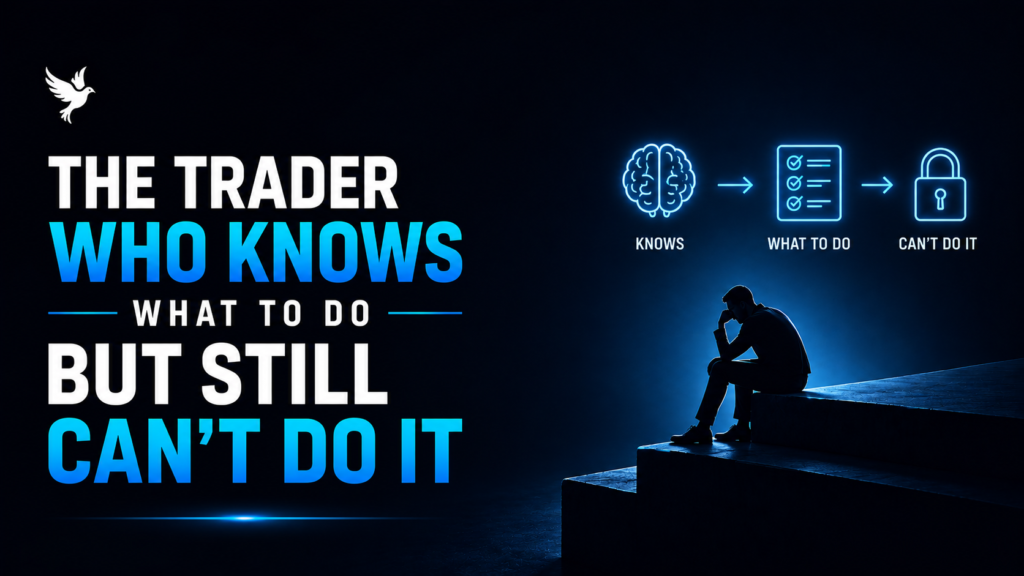
You Know What You’re Supposed to Do. So Why Don’t You Do It?
Let’s be honest.
Most traders don’t have a knowledge problem.
You probably already know that you shouldn’t risk too much on one trade.
You know you shouldn’t move your stop loss.
You know you shouldn’t revenge trade.
You know you shouldn’t chase the market.
You know you shouldn’t risk more just because you’ve had a winning streak.
You know you should follow your trading plan.
And yet, sometimes, you still do the exact opposite.
That’s one of the most frustrating parts of forex trading.
You can spend months learning technical analysis, studying charts, and building a strategy. But when the pressure of a live trade arrives, emotions can take over.
This is where trading discipline becomes critical.
Trading discipline is the ability to follow your trading plan even when fear, greed, FOMO, or frustration are telling you to do something else.
The problem isn’t always that traders don’t know what to do.
Sometimes, the problem is that they can’t consistently do what they already know.
And understanding why is one of the most important steps toward becoming a more consistent trader.
Knowledge Is Not the Same as Trading Discipline
Imagine someone tells you that exercise is good for your health.
You understand it.
You know you should exercise.
You may even have a gym membership.
But knowing exercise is good doesn’t automatically make you get out of bed at 5 a.m.
Trading works the same way.
Knowing that you should respect your stop loss doesn’t guarantee that you will respect it when you’re watching a trade move against you.
The difference is discipline.
Knowledge tells you what you should do.
Discipline helps you do it when you don’t feel like doing it.
And that’s where many traders struggle.
The Market Doesn’t Test Your Knowledge. It Tests Your Behavior.
Anyone can follow a trading plan when everything is going well.
The real test comes when the market does something you don’t want.
Your setup fails.
Your stop gets hit.
The trade moves against you.
You miss an entry by a few pips.
You watch someone else post a huge winning trade online.
That’s when your psychology takes over.
Suddenly, the rules you carefully wrote down don’t feel as important.
You start negotiating with yourself.
“Maybe I’ll give it a little more room.”
“I’ll just take one quick trade.”
“This setup is too good to miss.”
“I can recover the loss.”
And just like that, the trading plan becomes optional.
Why Do Traders Break Rules They Created Themselves?
Because emotions are powerful precisely when the consequences are immediate.
When you create your trading plan, you’re usually calm.
You can think logically.
You can calculate your risk.
You can decide exactly where your stop should go.
But when you’re inside a live trade, everything changes.
Now there’s money on the line.
Your brain isn’t simply analyzing a chart.
It’s reacting to uncertainty, fear, excitement, hope, and loss.
That’s why a trader can confidently write:
“I will never risk more than 1% per trade.”
Then increase the risk after three consecutive losses.
The rule didn’t change.
The emotional environment changed.
The FOMO Problem
Fear of missing out is one of the easiest ways to turn a disciplined trader into an impulsive trader.
You see a market moving quickly.
You weren’t in the trade.
The candles keep moving.
And suddenly your brain tells you:
“If I don’t enter now, I’ll miss the entire move.”
So you enter late.
The market pulls back.
Now you’re trapped in a position you wouldn’t have taken five minutes earlier.
The painful part is that you knew better.
You didn’t lose because you didn’t understand the market.
You lost because you couldn’t tolerate the feeling of watching an opportunity move without you.
That’s a psychological problem.
Sometimes the Real Addiction Is Being Right
There’s another reason traders break their rules:
ego.
Nobody likes being wrong.
But trading requires you to be wrong regularly.
You can have excellent analysis and still lose the trade.
You can identify the direction correctly and still enter at the wrong time.
You can have a strong setup and still get stopped out.
The market doesn’t care whether your analysis was intelligent.
Price simply moves.
When traders become emotionally attached to being right, they start doing dangerous things:
- Moving stop losses
- Refusing to accept invalidation
- Adding to losing positions
- Ignoring changing market conditions
- Holding trades far longer than planned
The goal quietly changes from:
“Make a good trading decision.”
to:
“Prove that I was right.”
That’s a very expensive shift.
The Most Dangerous Trader Isn’t the Beginner
It’s the trader who knows enough to be confident but hasn’t developed enough discipline to control that confidence.
A beginner may follow a strategy exactly because they don’t know enough to improvise.
An experienced trader can become dangerous when they start thinking:
“I know how the market works.”
That’s when rules start getting bent.
One exception becomes another.
One oversized trade becomes:
“Just this once.”
And eventually, the trader realizes that the problem isn’t their strategy.
It’s their behavior.
Your Trading Plan Shouldn’t Depend on Your Mood
Here’s an important question:
Can you follow your trading plan when you’re angry?
Can you follow it after three losses?
Can you follow it after three wins?
Can you follow it when the market is moving without you?
Can you follow it when you desperately need a winning day?
That’s where real trading discipline is built.
Not when you’re calm.
When you’re uncomfortable.
Anyone can follow rules when following them is easy.
The real edge comes from following them when breaking them feels better.
How Do You Turn Knowledge Into Discipline?
You don’t solve this by learning another strategy.
You solve it by making good behavior easier and bad behavior harder.
1. Define Your Rules Before the Market Opens
Don’t make important decisions while you’re emotional.
Before trading, determine:
- Maximum risk per trade
- Maximum daily loss
- Entry conditions
- Stop-loss rules
- Take-profit rules
- When you will stop trading
Make the decisions while you’re calm.
Then execute them when the market becomes emotional.
2. Make Your Rules Specific
“Don’t overtrade” isn’t specific enough.
Instead:
“Maximum three trades per session.”
“Manage risk properly” isn’t specific enough.
Instead:
“Risk no more than 1% per trade.”
The clearer the rule, the harder it is to negotiate with yourself.
3. Track Rule-Breaking Separately From Losses
This is extremely important.
A losing trade isn’t necessarily a bad trade.
If you followed your plan and lost, that’s part of trading.
But a winning trade can actually be a bad trade if you broke every rule to make it.
Start recording:
Did I follow my plan? Yes or No.
That number may tell you more about your future than your win rate.
4. Create a Consequence for Breaking Your Rules
If you break a major trading rule, stop trading for the session.
Not because you’re being punished.
Because you’re protecting yourself from making an emotional mistake twice.
The objective isn’t to eliminate mistakes completely.
It’s to prevent one mistake from becoming a chain reaction.
5. Review Your Emotional Patterns
At the end of every trading session, ask:
What was I feeling before my worst trade?
Were you:
- Bored?
- Angry?
- Excited?
- Afraid?
- Overconfident?
- Trying to recover a loss?
- Trying to prove yourself right?
Over time, you’ll begin to recognize your triggers.
And once you recognize them, you can prepare for them.
The Goal Isn’t Perfect Discipline
This is important.
You’re going to make mistakes.
You’re going to have emotional days.
You’re going to break a rule occasionally.
That’s part of being human.
The goal isn’t to become a robot.
The goal is to make your mistakes:
smaller, less frequent, and less destructive.
If you used to break your rules five times a week and now you do it once, that’s progress.
If you used to risk 5% when emotional and now you stop trading, that’s progress.
If you used to revenge trade for three hours and now you walk away after one loss, that’s progress.
Trading psychology isn’t about becoming emotionless.
It’s about learning not to let emotions make financial decisions for you.
The Question Every Trader Should Ask
The next time you break one of your own rules, don’t simply say:
“I’m undisciplined.”
Ask something more useful:
“What was I trying to avoid feeling?”
Were you afraid of losing?
Afraid of missing the move?
Afraid of being wrong?
Afraid of ending the day negative?
Afraid that someone else was making money while you weren’t?
That question can reveal more about your trading than another indicator ever will.
Because underneath many trading mistakes is an emotion we’re trying to escape.
Final Thoughts
You don’t necessarily need more information.
You may need better execution of the information you already have.
The market doesn’t care how many strategies you know.
It doesn’t care how many trading books you’ve read.
It doesn’t care how accurate your analysis was yesterday.
Every new trade asks the same question:
Can you follow your process when your emotions are telling you not to?
That’s the real battle.
And that’s why trading discipline matters so much.
The trader who knows what to do but can’t execute it consistently isn’t necessarily a bad trader.
They’re an unfinished trader.
The next stage of their development isn’t always learning something new.
Sometimes it’s learning to trust the rules they’ve already created.
Because eventually, trading becomes less about finding the perfect entry…
and more about becoming the kind of trader who can consistently execute a good process.
Knowledge gives you the map.
Discipline determines whether you follow it.
A Question for the Community
Be honest with yourself:
What’s one trading rule you know you should follow—but still struggle to follow consistently?
Don’t answer with what sounds good.
Answer with the rule that has actually cost you money.
Because sometimes, identifying the problem is the beginning of fixing it.

Responses